Pineapple Season Has Begun
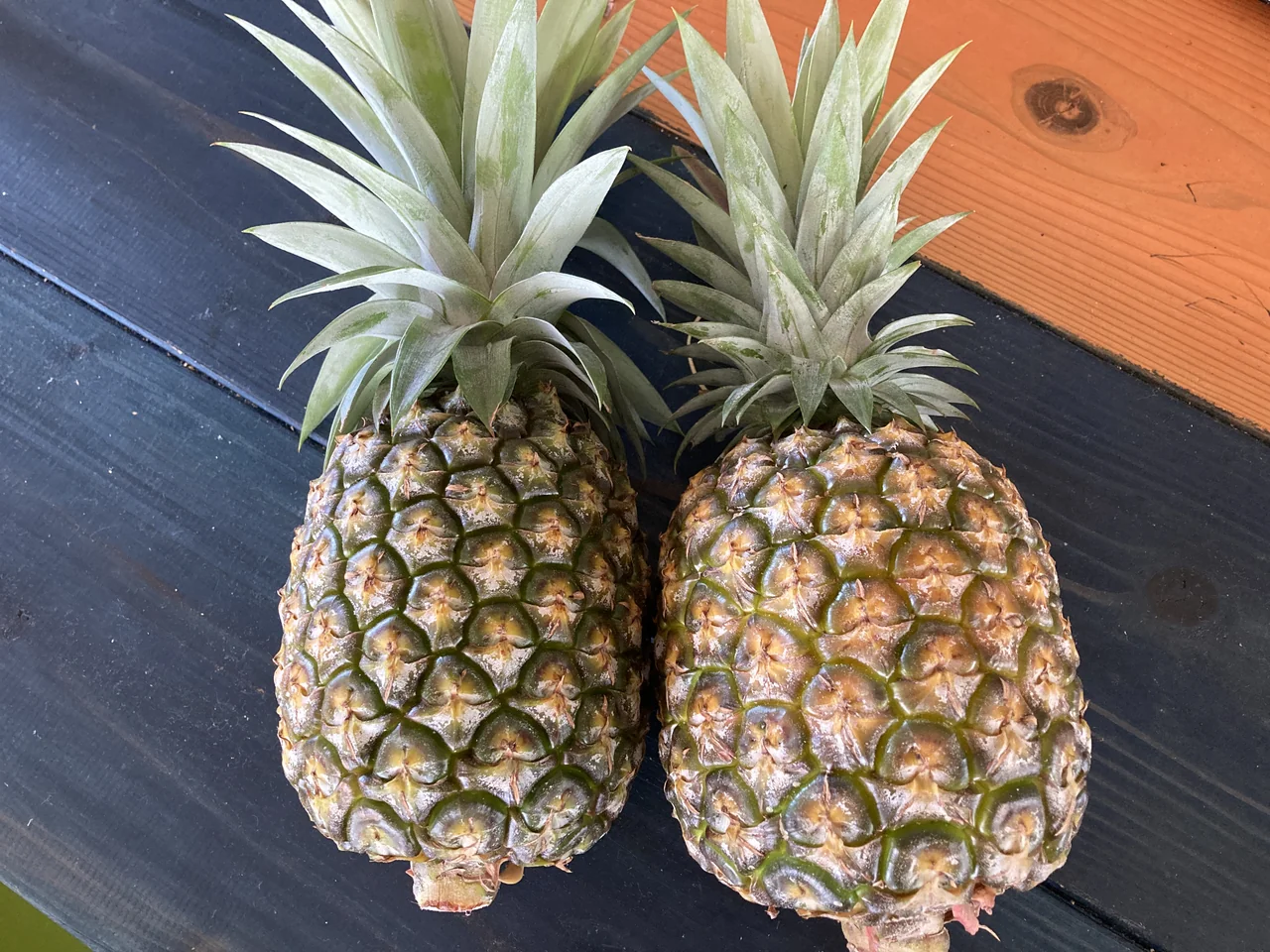
On May 1st, as pineapple harvests reach their peak across the region, the Okinawa Prefecture Pineapple Season Declaration was made. Once again, seasonal fruit carefully cultivated by local farmers is now available.
In Okinawa, the Prefecture Pineapple and Fruit Production Promotion Council has designated August 1st as "Pineapple Day" each year. Among the varieties grown in the prefecture, shipments of Pokotto (Bogor) and Peach Pineapple (Soft Touch) from Ishigaki Island and Iriomote Island begin as early as late March in some years, which is why May 1st marks the official start of the Okinawa pineapple season.
This year on Ishigaki Island and Iriomote Island, the harvest of Peach Pineapple and Pokotto began in early April. As summer approaches, varieties such as Juicy (Hawaiian variety), Gold Barrel, and White Coco will come into season one after another. According to JA Okinawa, Ishigaki Island plans to ship 700 tons of pineapples this year. Iriomote Island focuses mainly on direct-to-consumer sales through individual farmers, so please enjoy them through online shopping or by visiting the island. While the varieties are the same, the taste of pineapples can vary dramatically depending on soil quality and cultivation management.
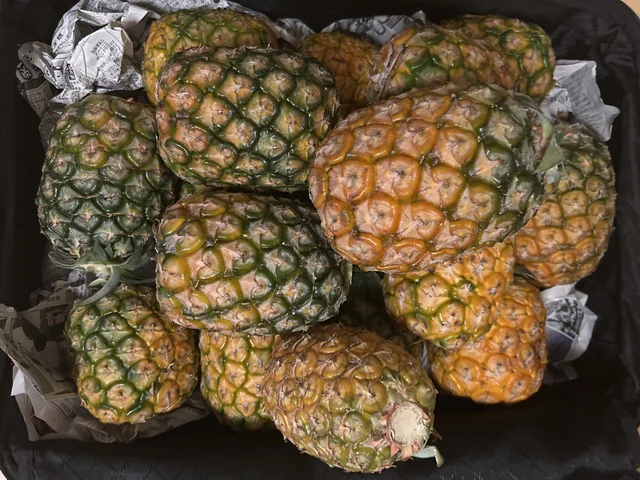
Pineapples carefully cultivated for two and a half years before harvest.
The Popular "Gold Barrel"
Recently, attention has focused on the "Gold Barrel," popular as a premium pineapple. While the standard small Bogor and the classic Juicy variety can be purchased for a few hundred yen, Gold Barrel—which is difficult to manage and grown by few farmers—trades at high prices. However, if purchased on Ishigaki Island, large fruits (approximately 2 kg) are sold at a reasonable price of around ¥2,000.
Why not try Ishigaki Island's sweet and juicy pineapples and mangoes this summer?
Incidentally, in our household, my wife and I prefer the Hawaiian variety, while our children love Peach Pineapple from Toume Farm.
The Kawara district, neighboring the Omoto area where our accommodation is located, is a major pineapple production area on Ishigaki Island, and pineapples from any farm there are delicious. The Kawara district also has unmanned sales stands, so please try truly delicious fully-ripened pineapples.
Fully-Ripened Pineapples Only Available on the Island
Pineapples do not ripen after harvest, so full ripeness is achieved in the field. However, for retail purposes, they are harvested before full ripeness to ensure shelf life, which prevents them from reaching their true delicious potential. Especially those shipped off-island are harvested while still immature, so the taste difference is stark. Please come to the island to eat fully-ripened pineapples. Moreover, fully-ripened pineapples cannot be used for supermarkets or shipping, so they're inexpensive!
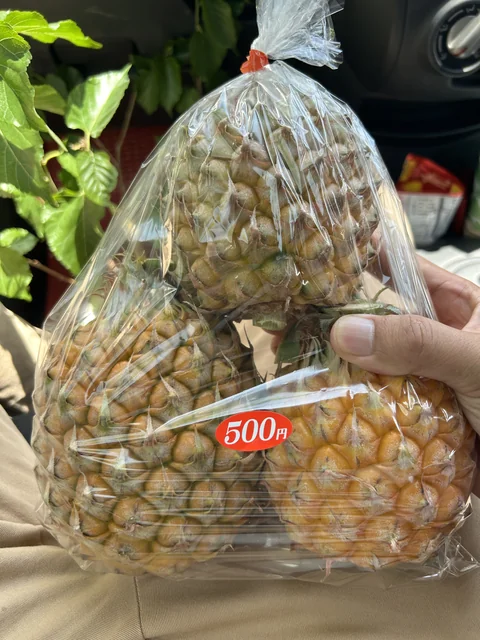
Inexpensive and delicious fully-ripened pineapples purchased from an unmanned sales stand.
Characteristics of 7 Okinawa Pineapple Varieties
Variety Name (Brand Name/Common Name) | Sweetness | Acidity | Harvest Period | Characteristics & Flavor |
|---|---|---|---|---|
Bogor | ★★★★☆ | ★★☆☆☆ | April–Mid-August | Fun variety that can be pulled apart by hand. Firm flesh, but edible to the core. |
Soft Touch | ★★★☆☆ | ★★★☆☆ | Late April–Mid-August | When fully ripe, emits a rich peach-like aroma. Somewhat small with very soft flesh. |
N67-10 | ★★☆☆☆ | ★★★★☆ | June–Mid-September | The main variety supporting Okinawa's tradition. Abundant juice, versatile for both fresh eating and processing. Large fruit at affordable prices. |
Gold Barrel | ★★★★☆ | ★★☆☆☆ | Late May–Early August | Premium brand developed over 20 years. Barrel-shaped large fruit with low acidity and rich flavor. Soft flesh, edible to the core. |
Julio Star | ★★★☆☆ | ★★★☆☆ | Mid-June–September | Variety developed for harvest at summer's end (August–September) with excellent shelf life. Abundant juice with sweet-tart, refreshing flavor. |
Okinawa P17 | ★★★★★ | ★☆☆☆☆ | May–November | The sweetest, creamiest variety among Okinawa's 7 varieties. Large fruit rapidly gaining popularity as a summer gift. |
Okinawa P19 | ★★★★☆ | ★★☆☆☆ | May–September | The latest large-fruit variety introduced in 2022. Characterized by a coconut-like tropical aroma. The softest flesh among the 7 varieties. |
History of Okinawan Pineapples
1. History of Okinawan Pineapples: Glory, Setback, and the Great Turnaround to "Fresh Fruit"
The history of pineapple cultivation in Okinawa dates back to the mid-1860s. It is said that when a Dutch ship ran aground off Ishigaki Island, seedlings that drifted to Kabira Bay were the first pineapples to reach Okinawa.
The industry began in earnest in the early Showa period. In 1927, an excellent improved variety called "Smooth Cayenne" was introduced from Taiwan, and commissioned cultivation began in northern Okinawa Island and on Ishigaki Island. Initially, it was a continuous struggle, but in the 1950s, farmers who immigrated from Taiwan used water buffalo to clear undeveloped land, finally putting large-scale cultivation on track.
2. The Golden Age as "Canned Pineapple Kingdom"
After World War II, under U.S. administration, pineapples became "a massive engine supporting the island's economy" alongside sugarcane.
In the 1950s–60s, fresh fruit imports were strictly restricted in Japan, so canned pineapples from Okinawa—the only tropical/subtropical region in the country—sold extremely well.
In 1967, from seedlings introduced from Hawaii, USA, the superior strain "N67-10 (Hawaiian variety)"—a labor-saving, high-yield type best suited to Okinawa's climate—was selected. It became a huge hit, and at its peak in 1969, production reached approximately 100,000 tons per year. Canned pineapple accounted for over 17% of Okinawa's total export value, and many "pineapple mansions" lined the northern districts during this golden age. On Ishigaki Island, large pineapple factories were also established, employing many workers. The site of the largest factory in Miyara is now home to Seifuku Shuzo's distillery.
3. The "Liberalization" Black Ship and Devastating Setback
However, the glory did not last. The 1972 return to mainland Japan, followed by the complete liberalization of canned pineapple imports in 1990, devastated Okinawa's industry.
Canned products from the Philippines, Thailand, and other countries—with overwhelmingly lower labor and land costs—flooded into Japan. Losing the price competition, Okinawa's canneries closed one after another, and production plummeted to less than one-tenth of its peak. A "winter era" arrived as farmers gave up cultivation and abandoned their fields.
4. The Miracle Joint Operation: A Great Reversal from "Quantity" to "Quality (Fresh Fruit)"
From here, Okinawa's pineapple industry embarked on an unprecedented "shift from canning (processing) to fresh fruit"—a major gamble. Unable to compete on price, they chose to compete with "overwhelming taste and uniqueness" that foreign producers could never replicate.
The Okinawa Prefectural Agricultural Research Center (formerly the Experiment Station), government agencies, JA, and motivated farmers united to develop and promote new varieties.
"Bogor (Snack Pineapple)" with the entertainment value of being hand-pullable
"Soft Touch (Peach Pineapple)" that surprised with its peach aroma
"Gold Barrel," the ultimate premium pineapple created over 20 years
These unique fresh pineapples quickly captured consumers' hearts, and by around 2000, fresh fruit shipments completely overtook processed products.
Varieties became diverse, and flavor was pursued to the point of rivaling authentic Taiwanese pineapples. When China restricted imports of Taiwanese pineapples, large quantities entered the Japanese market, but the feared impact did not materialize, and shipments did not decline significantly.
5. Into the Future: Okinawa Pineapples Continue to Evolve
Currently, Okinawa's pineapple production remains stable at around 7,500 tons, but nearly 90% is high-quality fresh fruit traded at premium prices. In recent years, new varieties have been deployed: "Julio Star," which extends the harvest season; "Okinawa P17 (Sun Dolce)" with rich sweetness; and "Okinawa P19 (White Coco)," the latest variety with coconut aroma—all masterpieces of Japan's advanced breeding technology.
Starting from a handful of drifted seedlings, battered by global waves yet miraculously reborn as a "premium brand fruit"—this is the story of Okinawan pineapples.
Okinawa Prefecture's Comprehensive Breeding Selection Criteria
Ease of Cultivation: Thornless leaves (to prevent worker injuries and improve management efficiency)
Fruit Quality: High sugar content (14 degrees or higher), low acidity, rich aroma
Appearance and Size: Appropriate size of 1–1.5 kg and attractive shape
Disease Resistance & Ease of Growing: Disease-resistant and able to withstand Japan's typhoons
Importance of Thornlessness
In production areas like Okinawa Prefecture, thorned varieties such as "Snack Pineapple (Bogor)" are also popular, but thorns make workers prone to injuries during cultivation and harvest, and post-harvest boxing is extremely labor-intensive. Therefore, from the perspective of labor-saving (ease of cultivation), "thornless" is positioned as one of the most critical criteria, as seen in varieties like "Yugafu" developed by Okinawa Prefecture.
Actual Selection Process
Through artificial cross-pollination, seedlings are grown from thousands of seeds (seedlings), and in the early stages, they are narrowed down based on growth speed and external characteristics such as "presence or absence of thorns." Later, once fruit is produced, only those that pass rigorous sensory evaluations for "high sugar content" and "texture" are finally selected. Thus, "thornlessness" and "deliciousness" function like two wheels of a car.
In this way, "thornlessness" for smooth cultivation management is treated as a mandatory condition (basic specification) for a variety to be released to the market.